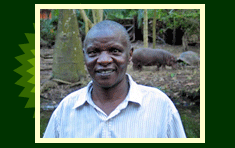
Stephen Tuei
Stephen is in charge of caring for Owen and Mzee at Haller Park. He works with the animals every day and knows a lot about them. Follow Stephen's experiences on his blog.
 
 
The Walking crawlies. Feb 19, 2008

The Lizards of Haller Park

NILE MONITOR LIZARD

Varanus niloticus - Monitor lizards are considered to be the most highly developed lizards, possessing a relatively rapid metabolism for reptiles, several sensory adaptations that benefit the hunting of live prey, and a lower jaw that may be unhinged to facilitate eating large prey animals. It has been said that the name of monitor lizards is derived from a superstition that the creatures would give a warning about the presence of crocodiles, the name actually resulted from a mishearing of the Arabic word oaran (lizard) as the German warnen (to warn), which was subsequently Latinized into monitor.

They all have very long claws and a tail which can be used to lash out at the smallest sign of aggression. Don't be fooled by their size, since a lash from even the smallest Monitor can leave a serious welt. Unlike many lizards, the monitor lizard cannot grow its tail back if it is lost.

Monitor Lizard Basking in Haller ParkMonitor Lizard Basking in the sun

Along with these natural defenses, the monitor uses poise to frighten off its predators. Standing alert with their heads to the sky, the monitor will often puff out their throats and whip their tail, putting on a fearsome display. Their ribs may expand slightly as they hiss making this lizard actually appear larger than it really is.

The monitor's diet consists of anything it can get its claws on, anything that it can fit in its mouth, from fish, beetles, whip scorpions, crocodile and birds, to eggs, crabs, other lizards, snakes, nestling birds, and squirrels.

Monitor Lizards chilling out Monitior Lizard chilling out

To reproduce, monitors often lay from 7-35 soft-shelled eggs in a hole dug near a riverbank or grove of trees along the water. Varanus niloticus lays her eggs in termite mounds. The heat from the termites in the mound helps incubate the eggs.

In Haller Park this lizard is distributed in all the wetlands of the Ecosystem and also at the Reptile Park where they are kept for a close range viewing and education purposes.

Agama Lizards

An agama is any one of the various small, long-tailed, insect-eating lizards. These Agama Lizards are found in open savannahs in Kenya, Ethiopia and throughout East Africa. They are terrestrial but also arboreal and prefer to flee to a tree when in danger. They are not poisonous, but can give a very painful bite. They prefer to eat ants and termites with occasional beetles and grasshoppers.


An Agama  Lizard - only reptile known to do press upsAn Agama Lizard - only reptile known to do press ups

The agama is mostly a docile lizard There are several identifiable behaviors in this species (head nod, head bob, challenge display, threat display, fighting, and basking). Head bobbing, also known as push-ups, is the raising and lowering of the head and chest. Hunting by vision, it sits in vegetation, under a rock outcropping, or in the shade and waits until an insect or small mammal walks by and then will chase the prey

Sally shares her dairy Cubes with a monitor lizard and Egyptian geeseSally shares her dairy Cubes with a monitor lizard and Egyptian geese

previous entries
   
Privacy Policy | © 2007 Turtle Pond Publications, LLC and Lafarge Ecosystems, Inc.